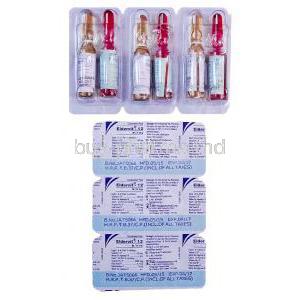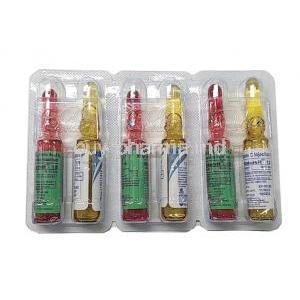


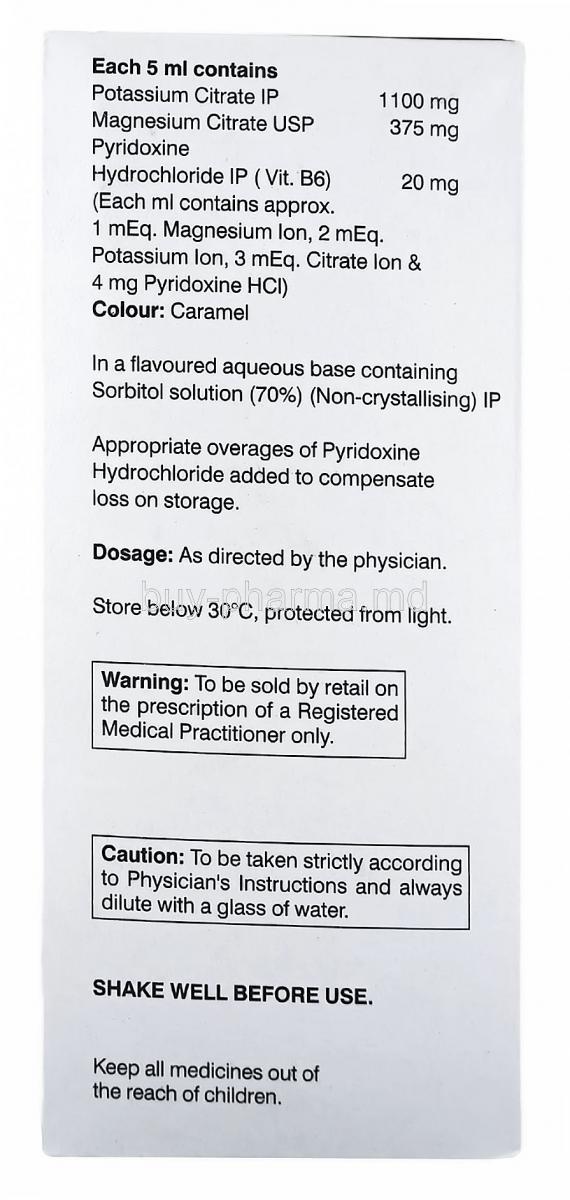
Introduction to Noculi B6 Liquid (Potassium Citrate / Magnesium Citrate / Vitamin B6)
Noculi B6 Liquid is a multi-component oral formulation designed to support urinary tract health and metabolic balance. It combines citrate salts with a key water-soluble vitamin, offering a targeted approach for conditions influenced by urinary acidity, mineral imbalance, and altered oxalate metabolism.
The formulation is commonly positioned in clinical practice as a preventive and supportive therapy, particularly in patients prone to recurrent urinary stone formation or citrate deficiency. Its liquid dosage form allows flexible administration and facilitates absorption in individuals who may have difficulty swallowing solid dosage forms.
Citrate salts and pyridoxine play complementary roles in maintaining physiologic homeostasis. Together, they influence:
- Urinary pH regulation
- Electrolyte equilibrium
- Oxalate handling and renal crystal inhibition
Composition and Active Ingredients
Potassium Citrate
Potassium citrate is an organic potassium salt of citric acid, characterized by its alkalinizing properties once metabolized. After absorption, citrate is converted to bicarbonate, contributing to systemic and urinary alkalization.
Its primary clinical relevance lies in urinary pH modulation. By elevating urinary pH, potassium citrate reduces the supersaturation of uric acid and certain calcium salts, thereby decreasing the propensity for crystal nucleation and aggregation.
Magnesium Citrate
Magnesium citrate serves as both a mineral supplement and a citrate donor. Magnesium is an essential intracellular cation involved in hundreds of enzymatic reactions, including those governing energy production and neuromuscular transmission.
In the urinary tract, magnesium can bind oxalate, forming soluble complexes that reduce calcium oxalate crystallization. Systemically, adequate magnesium levels support metabolic stability and neuromuscular balance.
Vitamin B6 (Pyridoxine)
Vitamin B6 is a water-soluble vitamin with a pivotal role in amino acid metabolism. It functions as a coenzyme in transamination, decarboxylation, and neurotransmitter synthesis reactions.
From a renal perspective, pyridoxine influences endogenous oxalate production. Adequate vitamin B6 status may reduce oxalate synthesis, contributing indirectly to stone prevention strategies.
How Noculi B6 Liquid Works
The therapeutic effect of Noculi B6 Liquid is driven by its capacity to modify the urinary milieu. Citrate salts are metabolized to bicarbonate, resulting in increased urinary pH and enhanced citrate excretion.
Citrate acts as a natural inhibitor of crystal formation by binding calcium ions, thereby reducing free calcium available for stone formation. This process interferes with crystal growth, aggregation, and adherence to renal epithelium.
The formulation exhibits synergistic activity:
- Potassium supports alkalinization and electrolyte balance
- Magnesium complexes with oxalate and stabilizes metabolic processes
- Pyridoxine modulates oxalate metabolism at the biochemical level
Through these mechanisms, the product contributes to a less lithogenic urinary environment.
Approved and Primary Uses of Noculi B6 Liquid
Prevention of Kidney Stones
Noculi B6 Liquid is commonly used in the prevention of recurrent nephrolithiasis. It is particularly relevant for patients with stones associated with low urinary citrate or acidic urine.
In calcium oxalate stone prevention, citrate reduces calcium availability while magnesium limits oxalate binding. For uric acid stones, urinary alkalinization increases solubility, facilitating dissolution and prevention of recurrence.
Management of Hypocitraturia
Hypocitraturia, defined as low urinary citrate excretion, is a recognized risk factor for stone formation. Supplementation with citrate salts corrects this deficiency and restores inhibitory protection against crystallization.
Urinary pH Modulation
Acidic urine contributes to the formation of uric acid and cystine stones. By raising urinary pH, Noculi B6 Liquid supports a more favorable biochemical environment within the urinary tract.
Off-Label and Supportive Uses
Beyond primary indications, the formulation is used as adjunctive therapy in patients with recurrent stone disease who require long-term metabolic support.
In non-acute settings, citrate supplementation may assist in the supportive management of mild metabolic acidosis, particularly when related to dietary factors or chronic conditions.
Additional supportive applications include:
- Management of high urinary oxalate excretion
- Nutritional supplementation in magnesium deficiency
- Correction of subclinical vitamin B6 insufficiency
Dosage and Administration Guidelines
General Adult Dosage
Dosage is individualized based on clinical indication, urinary parameters, and patient response. Typical dosing involves divided daily administration to maintain stable urinary citrate levels.
Therapy should be tailored according to laboratory findings rather than fixed dosing alone.
Administration Instructions
The liquid formulation is usually diluted in water prior to oral intake. Adequate fluid consumption is recommended to support urinary dilution and therapeutic effectiveness.
Administration timing may vary, but intake with meals can improve gastrointestinal tolerability.
Duration of Therapy
Short-term use may be sufficient for transient metabolic correction, while long-term therapy is often required in patients with recurrent stone disease. Periodic reassessment is essential to determine ongoing need.
Administration to Special Populations
Administration to Elderly Patients
Elderly individuals may exhibit age-related declines in renal function, necessitating cautious dosing. Regular monitoring of serum electrolytes and renal parameters is advisable to minimize imbalance risk.
Administration to Pregnant Women and Nursing Mothers
Use during pregnancy requires careful clinical judgment, weighing potential benefits against theoretical risks. During lactation, clinical discretion is advised, with attention to maternal electrolyte balance.
Administration to Children
Pediatric use should be guided by specialist supervision. Dosing must be adjusted for body weight and renal maturity, and safety data may be limited depending on indication.
Side Effects Overview
The safety profile of citrate-based combination therapies is generally favorable when used as directed. Most adverse events are mild, self-limiting, and related to gastrointestinal tolerance or electrolyte shifts rather than systemic toxicity.
Observed reactions can be broadly categorized into:
- Dose-dependent effects related to mineral load
- Patient-specific responses influenced by renal function and comorbidities
General Tolerability Profile
In clinical use, the formulation is well tolerated by the majority of patients. Liquid administration allows gradual absorption, which may reduce abrupt metabolic fluctuations compared with high-dose solid preparations.
Tolerance is typically higher when:
- Doses are divided throughout the day
- Adequate hydration is maintained
- Renal function is within normal limits
Dose-Dependent vs Patient-Specific Reactions
Dose-dependent reactions usually arise from excessive intake or rapid escalation. Patient-specific reactions, on the other hand, are often linked to underlying renal impairment, electrolyte disorders, or concurrent medications.
Individual variability plays a significant role in the manifestation and severity of adverse effects.
Common Side Effects
Gastrointestinal Discomfort
Mild gastrointestinal symptoms are the most frequently reported adverse effects. These may include nausea, abdominal discomfort, bloating, or diarrhea.
Such symptoms are often transient and may improve with:
- Administration with meals
- Further dilution in water
- Temporary dose reduction
Mild Electrolyte Disturbances
Alterations in serum potassium or magnesium levels may occur, particularly during prolonged therapy. In most cases, these changes remain within subclinical ranges and resolve with dose adjustment.
Transient Gastric Irritation
Local gastric irritation may develop due to the alkalinizing nature of citrate salts. This effect is usually short-lived and does not necessitate discontinuation in most patients.
Less Common and Serious Adverse Effects
Hyperkalemia Risk
Elevated serum potassium levels represent a clinically significant risk, especially in patients with impaired renal excretion. Symptoms may include muscular weakness, paresthesia, or cardiac rhythm disturbances.
Hypermagnesemia in Renal Impairment
Excessive magnesium accumulation may occur in individuals with reduced renal clearance. Clinical manifestations can range from lethargy and hypotension to neuromuscular depression in severe cases.
Metabolic Alkalosis with Excessive Use
Chronic or excessive intake may lead to systemic alkalosis. This condition can disrupt acid-base homeostasis and provoke compensatory respiratory or metabolic responses.
Allergic or Hypersensitivity Reactions
Rare hypersensitivity reactions have been reported. These may present as cutaneous eruptions, pruritus, or, in exceptional cases, angioedema.
Drug and Nutrient Interactions
Interactions with Potassium-Sparing Diuretics
Concomitant use with potassium-sparing diuretics may amplify the risk of hyperkalemia. Cautious co-administration and close laboratory monitoring are advised.
Effects with ACE Inhibitors and ARBs
Agents that affect the renin–angiotensin–aldosterone system can reduce potassium excretion. Combined use may necessitate dose modification and frequent electrolyte assessment.
Interaction with Antacids or Calcium Supplements
Simultaneous administration with calcium-containing products may influence mineral balance and urinary chemistry. Spacing doses may mitigate these interactions.
Impact on Absorption of Certain Antibiotics
Magnesium may chelate specific antibiotics, reducing their gastrointestinal absorption. Temporal separation between administrations is recommended to preserve therapeutic efficacy.
Warnings and Safety Information
Electrolyte imbalance remains the principal safety concern. Patients should be assessed for predisposing conditions prior to initiation.
Particular caution is warranted in individuals with:
- Chronic kidney disease
- Cardiovascular disorders influenced by potassium levels
- Concurrent electrolyte-altering medications
Regular laboratory monitoring enhances safety during prolonged therapy.
Contraindications
Use is contraindicated in patients with severe renal impairment, where mineral excretion is significantly compromised.
Additional contraindications include:
- Pre-existing hyperkalemia or hypermagnesemia
- Known hypersensitivity to any component
- Conditions associated with impaired potassium elimination
Careful Administration and Important Precautions
Baseline evaluation of renal function and serum electrolytes is essential prior to therapy initiation.
Ongoing monitoring should be individualized and may include:
- Periodic electrolyte panels
- Renal function tests
- Clinical assessment for neuromuscular or cardiac symptoms
Patients should avoid excessive dietary potassium intake unless specifically advised otherwise.
Overdosage and Emergency Management
Overdosage may result in significant electrolyte derangements. Potassium or magnesium excess can manifest with gastrointestinal distress, hypotension, or cardiac conduction abnormalities.
Prompt medical evaluation is critical. Management may include supportive care, electrolyte correction, and, in severe cases, advanced medical intervention.
Storage and Stability
The product should be stored at controlled room temperature. Exposure to excessive heat, moisture, or direct sunlight should be avoided to preserve stability.
Once opened, shelf-life may be limited. Adherence to manufacturer guidance ensures continued product integrity.
Handling Precautions
Accurate dosing requires appropriate measuring devices. Household utensils should be avoided to prevent dosing inaccuracies.
Safe storage away from children is imperative. Unused or expired product should be disposed of in accordance with local regulations.
Patient Counseling and Clinical Considerations
Adequate hydration is a cornerstone of therapy. Fluid intake supports urinary dilution and enhances therapeutic outcomes.
Dietary guidance may include moderation of sodium and oxalate-rich foods. Adherence to prescribed dosing and follow-up monitoring is essential for long-term safety and efficacy.
Noculi B6 Liquid, Potassium Citrate/ Magnesium Citrate/ Vitamin B6 (Pyridoxine) FAQ
Popular Products




Similar Product